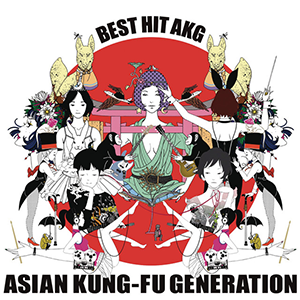
BEST HIT AKG
ASIAN KUNG-FU GENERATION
[review-body]
** reviewing this particular ASIAN KUNG-FU GENERATION album was a tough choice for a lot of reasons. attempting choosing which album resulted in disrespectful levels of indecision. in the end i’ve decided BEST HIT AKG to be the right first step. the compilation covers the greatest breadth of their early (and most known) discography. for the sake of music discovery, this felt like the correct place to start in approaching the band.
ASIAN KUNG-FU GENERATION (AKFG for short) is one of the most important musical influences in my teenage years, and thus my life. a taste-developing experience that found me at the right time. this is a band i’ve been eager to cover here for a very long time. it is easy to understate just how important the band and their early works are for me, for my taste in music today. this album was chosen not just as an accessible means of debuting their sound to the site, but to also cover as many of the songs that made them so powerful in the late 2000s. sure the review will be impacted by my teeming nostalgia, but i won’t let it influence me so much as to be negligent of proper criticism. i merely wanted to specifically mention just how much their music means to me as a person, not for the review, or the score, but to add a personal note of appreciation.
this one is for me. **
ASIAN KUNG-FU GENERATION exemplify their sound so succinctly in BEST HIT AKG, that even today it is their most streamed and listened to release. even though they are still proliferate as a band today, i don’t believe anything will quite match their star power in the late 2000s. compiled into one release of various albums up till this point in their career, BEST HIT AKG offers the greatest of AKFG’s sound with only some drawbacks. without the b-sides and the deep cuts, BEST HIT AKG is able to meet its greatest potential in showcasing the band, however some of their most interesting texture and contrast is lost in the process. without the deviations into their experimental pathways, BEST HIT loses some of the impact that made their best… well, best. and when everything is best hit, not EVERYTHING can be best hit. yet indulgence always seems to win out in the end. its tough to complain when some of the greatest Japanese pop-rock songs of all time are in hand’s reach. including some of their misses, BEST HIT AKG is truly (mostly) hits.
across the album is an impressive representation of their sound across many albums. its an impressive feat to release one solid album, let alone six great albums from 2003 through 2011. while most fans would contend Sol-Fa as their greatest album of all time, why not include them all into one nice package. even some of my favorite deeper cuts exist here, making it an equally impressive feat in curation. its cool to have “Rewrite” and “Haruka Kanata”, but including “Blue Train” “Aru Machi no Gunjou” and “Solanin” is the right level of attention to detail. and while i do not agree with every song choice present here, it is only from personal taste. even the songs i struggle to connect with are ones i’ve also spent years listening to due to their massive popularity. “Kimi to Iu Hana” might be overplayed, but it still marks a meaningful point in their discography. trimming a few songs such as “Marching Band” “Shinseiki no Love Song” and “Fujisawa Loser” would tighten up the hefty 17 track album length. not because they deserve any less love. i suppose that’s the hitch of having a compilation. you want some deep cuts and you want some choices gone, it just can’t be everything.
beyond this are a line of career defining songs that have not only boosted AKFG’s career once, but multiple times into hall-of-fame levels of recognition. mention to any Naruto fan of “Haruka Kanata” or any Bleach fan to “After Dark” or any OG Fullmetal Alchemist fan on “Rewrite” and you’ll be sure to recoil from bombastic and immediate praise. my favorite story being that i had gone to see their very first United States concert (very subtle flex) in Los Angeles and found the most dedicated and starved fans collected into one very small venue. the band had to acquiesce singing partway through “Haruka Kanata” not only because a concentrated group of English-only speaking people were reciting the song in unison, word-for-Japanese-word, but also because they were in awe of the sheer energy in that room, for their music. hundreds of American people cramped in one room to express their fandom for an anime and a song they had grown up and identified with. because of one song, global cultural and language barriers fizzled to nonexistence. that’s powerful stuff. “After Dark” was my personal favorite at the time. aside from Bleach, the song was the very first track on my first mp3 player. every time i powered it on, “After Dark” would play. in secret shame of loving Japanese music (it was just part of the times), it also became one of my most listened to songs of all time. when i first heard it, it blew me away. i had never, in all my life, heard music like this. it was so foreign, so mysterious, so powerful. today it might feel normalized, but at the time, with no hyperbole, it was a song that felt truly revolutionary. while my sister fell in love with the Killers, i was finding something else. yet somehow so very similar. last is worth mentioning “Rewrite”. not because this review needs a final story or history lesson, but because i think this may be, and still is, the best song the bad has ever made. not only a competitive bar to meet, but one barely touched by it contemporaries. “Rewrite”, even today, has got to be one of the most explosive and wild songs i’ve ever heard. goddamn. for all 226 seconds, from the first moment, the song hits 100 and does not give up any ground. a relentless song that only pushes itself further into its own fever. with the lead singer’s Gotoh Masafumi’s iconic voice, his gritty yelling only amplifies the song’s effects. even the mid-song reprieve yields for a mere 30 seconds before amping even further than before. not only is the song iconic from it’s equally explosive anime debut scene, but it remains the clearest thesis of the band to date. at the peak of their output does “Rewrite” exist.
my personal favorites are less well recognized, but i find them to be in the band’s most engaging styles. covering their blind spots and improving their diversity in a way that held my appreciation for the band, long after “After Dark” became an old burnt out song on my mp3. in these songs are where AKFG explores its darker, stranger, more stylistic expressions. i’ve heard “Haruka Kanata” more times than even i’d care to at this point in my life, yet “Aru Machi no Gunjou” seems to have only increased in playtime the past couple of years, to a frequency of its inclusion in my Spotify most played lists.
“Aru Machi No Gunjou” has atmosphere. the diegetic city sounds and footsteps of background people place the song squarely in a scene. a guitar plays in loneliness over the urban babble. it’s somewhere in the first 20 or so seconds that the song is able to express profound loneliness, solitude in a crowd. a loneliness not lost but bolstered by the intense fire of the the remainder of the song. i’ve never heard anything like it. it has an incredible sense of place and emotion. the rest of the song only outlines the theme with an extreme edge.
“Blue Train” seems to take a departure from AKFG’s usual sound. it feels a little more math-rock leaning. which, when fused with their traditional style, becomes one of their most compelling divergences. the song feels methodical in execution. yet its the subtle build over its run-time that propel it to something unique. the songs accrues beat and feeling throughout. even in the breaths it takes between, they only feel like a re-composure to continue to gain and build momentum. i’m pleased with its inclusion on the album. easily overlooked, “Blue Train” only diversifies AKFG’s best attributes. it remains one of their most unique songs that also stands impressively well against the rest.
“Solanin” feels like a revisit to that lonely space from “Aru Machi no Gunjou”. a second drive into emotions more complicated, more layered and intricate. the poignant feelings are ones we can barely untangle. the song summits early in its run-time, and from there is a downhill avalanche. on its ascent, is a feeling of actualization, a de-burdening. “Solanin” feels like touches of warm sunlight through the collection of heavy rain clouds. once the peak has been, the rest tumbles down. the group lets loose its constriction into a free fall of instruments. the drums go wild, the bass zones in, the guitar unleashes, Gotoh sings into exhaustion. by the last handful of seconds, the whole production peaks out out the recording devices. “Solanin” embraces the nebulous emotions AKFG is so great at exploring. it’s not about what exactly you felt, but how you felt.
beyond their best songs, some others included may dither the whole experience. as mentioned before, they are not exactly outliers, or unwelcome, they are merely just not as great as a band that has some truly greats to offer. and while i do lement that some of the album’s b-sides or deep cuts could not be included, i also recognize the ones present are exactly the songs that need to be there. without them, the album would lose even greater contrast. the one that exists within it now is most likely what it should be. they simply are not to my personal taste.
AKFG unearths a deep range of styles and feelings throughout their tenure depicted in the album. it is far beyond me to exact a pin in any one point of their emotional representations. however, i don’t think i’m meant to. ASIAN KUNG-FU GENERATION has spent their career expressing themselves in obtuse and incredible ways. they have spent multiple albums and tracks exploring these complex feelings. why not let a hand-picked collection of their works place that pin for them, for me. despite the drawbacks of some songs that i find dilute the experience a bit, i cannot argue their popularity or range, especially within the fanbase. BEST HIT AKG may lack a deep contrast, for better and worse, of their individual albums, but it makes up for it in a sheer collection of powerful expressions across their earlier history. BEST HIT AKG may not be the definitive way to understand the band, one could dutifully listen through each album in chronological order, or they could simply search up BEST HIT AKG and hit play.
[review-footer]
Highlights
Haruka Kanata (遥か彼方)
Mirai no Kakera (未来の破片)
Rewrite (リライト)
Loop & Loop (ループ&ループ)
Blue Train (ブルートレイン)
Aru Machi no Gunjō (或る街の群青)
After Dark (アフターダーク)
Korogaru Iwa, Kimi ni Asa ga Furu (転がる岩、君に朝が降る)
Mustang (ムスタング)
Solanin (ソラニン)
Tracklist
Haruka Kanata (遥か彼方)
Mirai no Kakera (未来の破片)
Understand (アンダースタンド)
Kimi to Iu Hana (君という花)
Rewrite (リライト)
Kimi no Machi Made (君の街まで)
Loop & Loop (ループ&ループ)
Blackout (ブラックアウト)
Blue Train (ブルートレイン)
Aru Machi no Gunjō (或る街の群青)
After Dark (アフターダーク)
Korogaru Iwa, Kimi ni Asa ga Furu (転がる岩、君に朝が降る)
Mustang (ムスタング)
Fujisawa Loser (藤沢ルーザー)
Shinseiki no Love Song (新世紀のラブソング)
Solanin (ソラニン)
Marching Band (マーチングバンド)