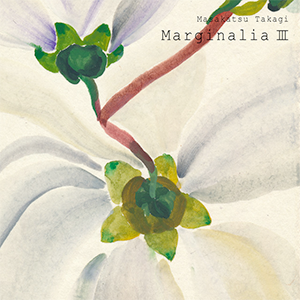
Marginalia III - Masakatsu Takagi
ambient/ modern classical • 2021
8.7
on my first trip to japan i ended up staying in the onsen town, Hakone. a quiet hot spring town nestled in the wooded hillsides southwest of Tokyo. this trip had been a lifelong dream and, having just finished climbing Mt. Fuji the day prior, i was already in an exhausted calm state. in this onsen town i happened to find one thing that particularly stood out to me in a long trip of impactful highs, the sound of evening cicadas in japan’s country mountainside. i was walking back to the hotel after a mute hour of laundry, which was seamlessly derailed when i was assaulted in every direction by one of the most unique, and beautiful sounds ive ever heard. a mechanical chorus, a crying that echoed out from every inch of the forest around me. a sound that thoroughly filled up every inch of space in that wooded mountainside. evening summer cicadas. so i dropped my clothes off at the onsen and went cicada hunting for the next hour or two. it was one of the most tranquil and illuminating experiences ive had in my life so far. the japanese countryside exploded to life that summer evening, as im sure it does every summer evening. for a small fraction of that trip i felt like i had finally found that part of japan i had been looking for the whole time. the part secluded in nature. the part far away from everything else.
Masakatsu Takagi is somewhat known for his music work on Mamoru Hosoda’s films (Wolf Children, Mirai, The Boy and the Beast). while ive found the films and their atmosphere enjoyable, ill admit that theyve never particularly stuck out to me as worth digging into deeper. off the back of listening to Yorushika’s fantastic “Nininshou” (more specifically “Kitsusugi”) i was led down a tiny rabbit hole of ambient/ instrumental music coming from Takagi. in fact, he has a long and still growing collection of music in this very form. he has created a peaceful and austere collection to enjoy before moving along to your busy life.
its a rather airy album with a wide open sound stage and, in that wide open stage, a minimal use of sounds and instruments to tell the barest story. Takagi uses the sounds of the japanese countryside to place a very distinct atmosphere. an atmosphere that could only truly come from someone that grew up living in a place like this. in this place birds chirp, cicadas cry, cricket hum, water flows, wood creaks, an old lady sings, rain drips, thunder growls and grass rustles, among many other delightfully authentic noises. the piano that plays along is more of a step-in companion to the music of ambient nature. it eases us into the beginning of the album to get us acquainted with the space, then mysteriously fades off into the background as the ambience fills our ears. the piano pops back in for short little ditties and longer statements, some parts playful and others more somber and collective. however the piano never really overshadows and never fully takes the reigns. this album thrives on the companionship between environmental feeling and minor human impressions.
deeper into the album takes us from daytime’s glory to that of golden evening. the stage shifts away from playful chirping birds and dancing grass to amber twilight dominated by cicadas. a shift in nature and tone actively felt throughout the album. at one point a rainstorm brews somewhere out of range, and at another we enjoy the lively hum of nighttime routines. one of my favorite pieces, “Marginlia #61,” gives us the warbling of an old woman singing along to herself. as if she has done this for years and years, we are just visitors to her quiet evening work. track “Marginalia #65” is a piano centric display that feels in unison with the birds loudly squeeking and pipping through the composition. “Marginalia #66” sinks a bit deeper into the evening with frogs croaking and the somber crackling of a light rain on various surfaces. here, once more, the woman sings in agreement with nature and the piano. each song a step into a new space to let us feel what Takagi feels.
personally, i find the step away from so much hustle and chaos necessary. call it what you will. the older i get, the more this kind of sound appeals to me. a place to escape, to take a breath, to relax, to reprieve. while i wander around my home working on my various hobbies and chores, i find the sound of Takagi’s work, in its own way, engaging. vital. “Marginalia #72” is my personal favorite. the deep cry of the cicadas, the “higurashi” and their inescapable, persistent, metallic choir, brings me so wholly back to that evening after laundry in japan. so much so i had to stop everything i was working on at first listen, for 8 full minutes, just to soak it all back in, to remember. and maybe thats Takagi’s goal. his work here is a way for him to engage with the nostalgia of growing up in this place. his work is a way for him, and others like him, to come back. memories are a powerful thing, and we engage with our them in our own way, in various ways. to find that Takagi has completely and effectively wielded music to take me back to such a particular and treasured memory, is an astounding commendation.
a simple complaint i have is that when a complete work like this is so ambient and subdued, when any personality shines through, it becomes indelible. the piano that plays more distinct pieces throughout the album can become too noticeable for my liking. i could argue that it gives us, the audience, something to grasp on to, so as not to get lost in the ocean of ambience. however i find myself skipping some of the tracks on re-listen. “Marginalia #83” feels like the right kind of accompaniment, whereas “Marginalia #65” comes with too much purpose and identity. both tracks have their place in establishing the album, however i find that i prefer “#83”s style more. when the piano is too prominent, it takes away from the seamless, unbroken, natural atmosphere. the piece becomes more song than passive experience. for this album, i am here for the passive experience.
Takagi clearly has a gift for establishing place and time in his work. any person who works closely with art knows that restraint (usually) breeds stronger work. that restraint is perhaps the most difficult lesson to learn and employ. Takagi seems to thrive in this restraint. holding back so much as to let the sounds of nature exist, breath and play their own powerful composition. he just adds a bit of piano here and there to be a small part of it, of a greater whole. like humanity, nature overcomes us, we are just short term visitors. a master of his craft, Takagi holds back in all the right ways.
it is not often i can find some piece of media that abducts me away how “Marginalia III” has done. willfully, i go every time.
written by Marcus Landeros
- highlights -
Marginalia #59
Marginalia #61
Marginalia #71
Marginalia #72
Marginalia #75
track list:
Marginalia #48
Marginalia #60
Marginalia #62
Marginalia #61
Marginalia #66
Marginalia #71
Marginalia #75
Marginalia #76
Marginalia #65